Just as with his Knuffle Bunny books, Mo Willems' creativity shines through in Hooray for Amanda & Her Alligator! The table of contents announces that the book contains, "6 1/2 Surprising Stories About 2 Surprising Friends."
With the first story we meet Amanda's alligator, and I was smiling from the first page because of his personality. I continued to do so throughout the book. For example, on one page the alligator is dismayed to find out that he was only worth seven cents. Before Amanda reveals that he was in the sale bucket, the text states, "(When friends ask you to tell the truth, you tell the truth.)" (p. 41).
At 68 pages, the book is long compared to many picture books; however, there is not a lot of text on each page, so it is a great transitional book to build stamina for readers who are gaining more confidence. They can get familiar with the "chapter book" concept from the comfort of a picture book by a well-loved author.
Sunday, February 12, 2012
Tuesday, February 7, 2012
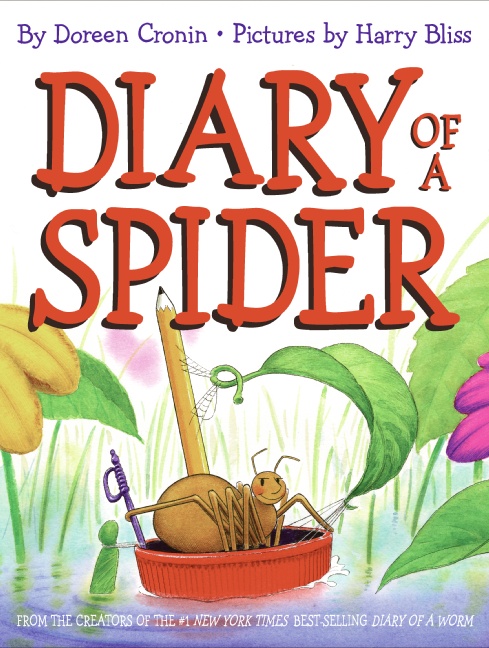
Diary of a Spider
My daughter has brought home and really enjoyed Doreen Cronin's Diary of a Worm from her classroom library. I wanted to revisit this author by reading Diary of a Spider.
As with Diary of a Worm, in Diary of a Spider, real facts about spiders are mixed in with fictional elements, such as the spider going to school and other behaviors that reflect human life, rather than that of spiders. In addition, Harry Bliss is the illustrator for both books, so the book will feel familiar for those who have previously read the first book.
Throughout the book there is a lot of humor, which is sure to be one of the aspects that draw many kids to the books. Among the humor are subtle lessons. As much of the events in the book relate to humans, kids can learn from the emotions and actions in the book.
Because the book as set up as a diary, there are many random events, rather than one cohesive plot. As such, readers never know for sure what will be waiting for them as they flip the page, a fun element of surprise.
I noticed that Cronin has many other Diary of... books. They will be fun to explore.
Monday, February 6, 2012
Fishing in the Air
When I was student teaching I read my first Sharon Creech novel, and she quickly became one of my favorite authors. However, I am still unfamiliar with her picture books, other than Who's that Baby? When I saw her first picture book Fishing in the Air at the library, I didn't have to think twice before adding it to my stack.
The book recounts the story of a boy going fishing with his father, but it is not just about the actual fishing, it is about the whole experience. Leaving bright and early in the morning and including the conversations along the way. The dad has quite an imagination and inspires his son to see the world in a different way.
The composition of the pages was different, rather than being the same on every page - at times the watercolors swirled all over the pages, only leaving a small rectangle of text, while other pages had a lot of white space with a small image accompanying the text. However, the text always appeared in the same location on the pages, making the book form an overall cohesive feel.
I have to admit, when I read that the book was about a father-son fishing trip, I was not sure that I would like it all that much, since that experience is so far removed from my own. However, I was pleasantly surprised to see that I loved catching glimpses into this father-son relationship, as well as this specific bonding moment. This would be an excellent book to include in a genre study related to narrative writing, sharing the aspect of personal experiences with family.
Sunday, February 5, 2012
D is for Drinking Gourd
D is for Drinking Gourd: An African American Alphabet by Nancy I. Sanders and illustrated by E. B. Lewis caught my attention because I had recently read Gathering the Sun, another cultural alphabet book. I also absolutely loved the cover image.
The inside of the book has art consistent with the style that caught my attention on the cover. Aside from the art, another aspect that I loved right away was that each page told part of history and/or contributions that African Americans have made in the US. Letters featured a range of aspects such as: Harlem Renaissance, inventors, jazz, the Little Rock Nine, athletes, organizations, and holidays. Some pages had celebratory tones, while others were more somber, sharing difficult aspects of history.
With the letter A, the left hand side of the two-page spread had four lines of poetry, "'Let our people go!' they cried / in speeches or with a pen in hand. / A is for abolitionists / who were willing to take a stand." The featured letter, A, was in a larger font to catch the reader's attention. The water color image spanned the two page spread, but about 1/3 of the right hand page was set off by a solid background color. It had the featured letter in upper and lower case in large text, followed by more historical information in smaller font than the rest of the page. Many of the pages followed this same set up, while others featured two letters, each with the same components on a single page, rather than the double-page spread. As such the lay-out of the book was crisp, consistent.
When I got to letter E, I realized that at least 2 of the four lines of each of the poetry rhymed. As such, there is another added layer to the text, including both poetry and expository writing, making it a perfect mentor text for multi-genre writing.
I always love books like this when I find them because they can be read and enjoyed in multiple ways for multiple age groups and reading levels. For example, it is perfectly fine for some readers to simply read the left hand statements, while others will read all of the text, and some might elect to read the right hand text for the information that especially piques their interest.
While this book is appropriate for older primary readers, it would also provide a lot of background information for older students. For example, I can picture it being valuable for middle schoolers interested in any of the various aspects of history mentioned in the book. When reading the information correlated with the letter F, discussing African American's role in wars in the US, I thought about how it would complement books such as Laurie Halse Anderson's Chains. Other pages made me think of Christopher Paul Curtis' books. This is a book that I will want to buy a copy of for my 6th-8th grade classroom library!
Saturday, February 4, 2012
Eating the Alphabet
Lois Ehlert is one of the authors that I frequently notice when I am reading resources about emergent literacy, so I wanted to look for her books at our public library. One of them was Eating the Alphabet: Fruits & Vegetables from A to Z.
The end papers have small images of various fruits and vegetables in neatly arranged rows, while the title page has a silly face made out of fruits and vegetables, a sure hook for young kids.
After the following introduction on the first page, "Apple to Zucchini, come take a look. Start eating your way through this alphabet book," the rest of the book features fruits and vegetable words letter by letter, along with colorful watercolor illustrations. Each fruit and vegetable name is written twice, once in all capitals and again in all lower case letters.
Though there are many everyday fruits and vegetables, there are others that are less common, such as: gooseberry, kumquat, quince, and radicchio. Of course, what seems everyday or rare for me could be the opposite for others. Some that are common to me now, such as jicama and mango, were an everyday aspect of my husband's childhood and unknown to me until I was an adult. I love that a book like this can open up conversations with the girls about differences in their parents' childhoods. In a school context, kids could talk about which foods they are familiar with. In addition, I love that the end of the book has a glossary of the fruits and vegetables in the book, providing details about those that had me wondering.
This book has a lot to offer. The use of capitals and lower case can help students become aware of letter counterparts, noticing the connections of different ways to write the same letter. In addition, the book would be a perfect fit for a food themed unit. I especially like that the focus was narrowed to fruits and vegetables, so it could also fit in with a health related unit, rather than just food in general. When my oldest was first born I received Ehlert's Growing Vegetable Soup, which would be a great book to pair up with Eating the Alphabet for food-related units.
Friday, February 3, 2012
Chalk
Chalk by Bill Thomson was the only one of the four wordless books that I read with my daughters, and they absolutely loved it. At first I started by talking about the pictures, but slowly it shifted into telling a story. When I was finished my five-year-old asked me to read it again. The second time I read it more like a story and with more expression for individual characters since I had a better understanding of the big picture. Then, my eight-year-old wanted a turn reading it, followed by my five-year-old, who especially loves to play with different voices.
In the book three kids are walking in the rain. They spot a gift bag hanging from a t-rex at the park (as shown on the cover) and discover that the bag contains chalk. It does not take them long to realize that it is not just ordinary chalk as they discover that whatever they draw on the concrete becomes reality. Their wonder quickly turns to horror as one of the drawings leads to a dangerous scenario, making readers want to flip the page to see just what will happen.
As we sat on the couch after school, flipping through the pages and delighting in the illustrations four different times, I thought more about the value of wordless books. My youngest is still emerging as a reader. Though she knows some sight words and is able to "read" familiar books or books with a lot of patterns, at times I can tell that she doesn't quite feel a part of the reading club yet. She absolutely loves books and enjoys "reading the pictures" but at times I can tell that she can't wait to be able to read the words by herself just like her sister. With a wordless book, the three of us were on equal terms. My youngest was not worrying about not being able to read the words yet, as she was able to focus on the value of creating a story based on the pictures.
An additional benefit is the value in oral rehearsing for writing development. By allowing for multiple variations of the story and developing details about different characters and events, wordless books can support creativity with storytelling. For primary students in a writer's workshop setting, having wordless books in the classroom can help them to foster a higher value for telling a story solely through pictures, especially when that is their stage of development. I am also thinking about the possibilities for collaborations between older students and primary students. For example students from older grades who are able to write stories, could study wordless books as a genre study, create their own books with the younger students as their target audience and then share them with kindergarten or first graders.So many possibilities for wordless books...
Wednesday, February 1, 2012
Flotsam
Prior to reading the jacket of David Wiesner's Flotsam, I was not aware of the meaning of the word. The wordless book highlights different materials that could be floating in the sea, washing up on shore for people to explore.
When I saw the title page with various objects, including shells and a feather, I thought about how my girls would probably love this book. Then the first page zooms in on a crustacean with a large eye closely examining it in the background. Something about the way it is presented, made me want to laugh, instantly hooking my attention and making me want to see more.
The next page zooms out to show more of the background scene, including the boy looking at the creature through a magnifying glass. Shortly after, the curios boy notices a mysterious camera that has washed up on the beach. That is when the book shifts from realistic to imaginative. He rushes to develop the film inside and sees glimpses into life under the sea. Amazed at what he is seeing, he zooms in to examine the little details of photos using his microscope.
Similar to the other two wordless books that I have reviewed in the series this week, there are many details in the pictures that spark the imagination. Kids would be able to talk about where fact and fiction blend, considering which aspects occur in real life. They can also consider the possibilities of what else might wash up on the shores of beaches and make them excited for a trip to the coast.
*Caldecott Medal Book
Subscribe to:
Posts (Atom)